Saturday, April 02, 2011

Painting Kids from Life


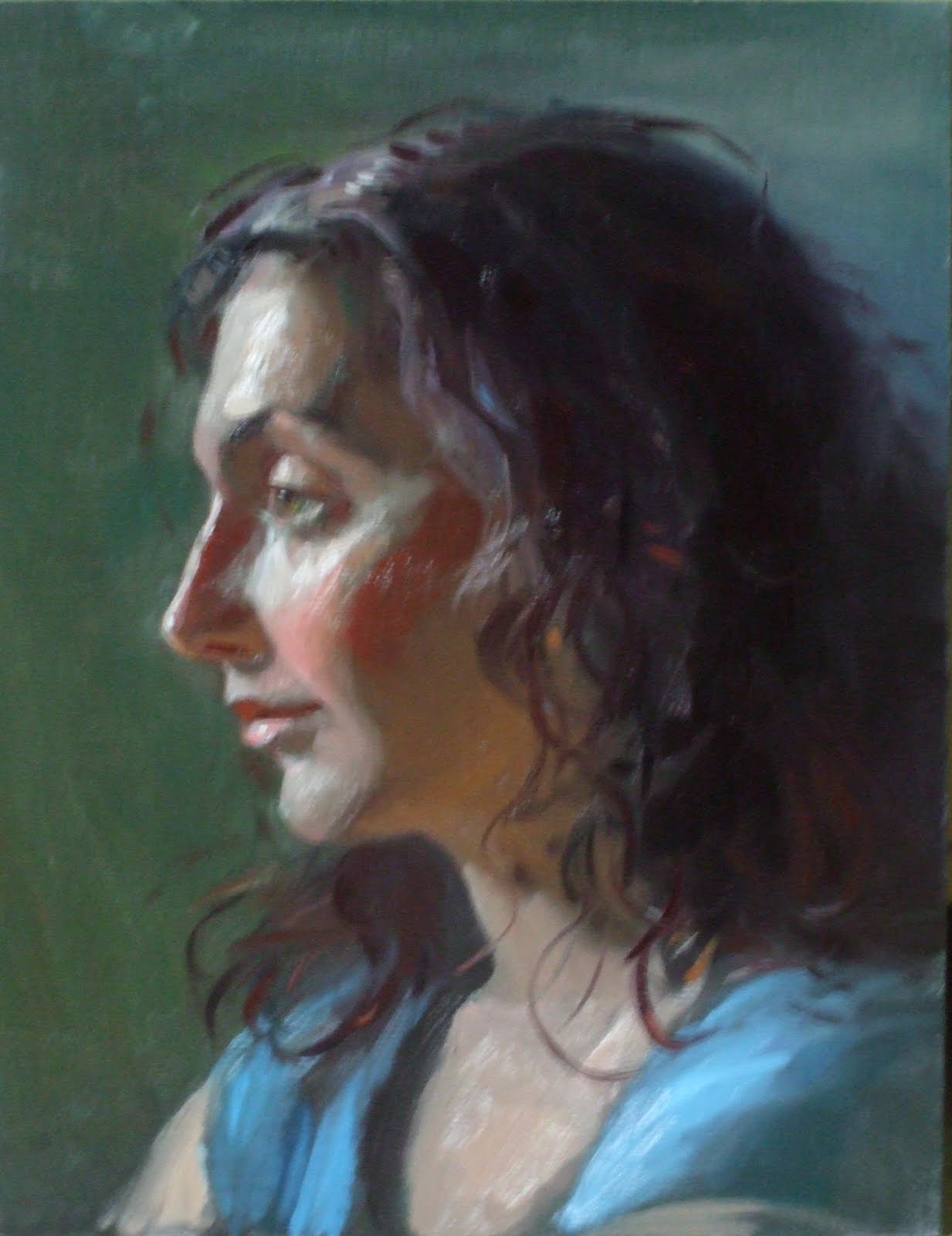
I painted my kids as often as a could get them to pose. I always worked from life, so most of my paintings were small, fast, alla prima studies. My kids are now grown, and I am now painting my grandkids. Violet Pepper posed for about 35 minutes on Thursday. Here are a few photos. As you can see, posing is not really posing. Kids move. They wiggle. But if I can get her to look in a general direction once in a while, I can concentrate on the light and shade. Mostly, we talk and laugh. The top photo is as far as I got, before she had to go to the dentist. Hopefully, I will be able to continue this one, because it was a fun start.

Saturday, March 26, 2011

Etching


In addition to painting and drawing, I etch. Etching is the process of making pictures on a metal plate by the corrosive action of an acid. To "etch" literally means to "bite".

An acid resistant ground usually containing beeswax and rosin is carefully applied to a polished copper plate. Where the artist draws, the ground is removed exposing the copper. When the acid is applied to the plate, the acid "bites" or corrodes the exposed metal, leaving lines or furrows. The longer the acid remains on the exposed copper, the deeper the furrow or lines, and the deeper the line the darker the line will appear when the plate is printed.

Etchings can go through many "states" or stages, where lines are added, subtracted, or strengthened. This requires varying the exposure time to the acid, by stopping-out lines that have been sufficiently bitten, redrawing and making corrections. A plate may be re-ground, re-worked and re-bitten many times. Also, parts can be removed by scraping and burnishing the plate with special tools.

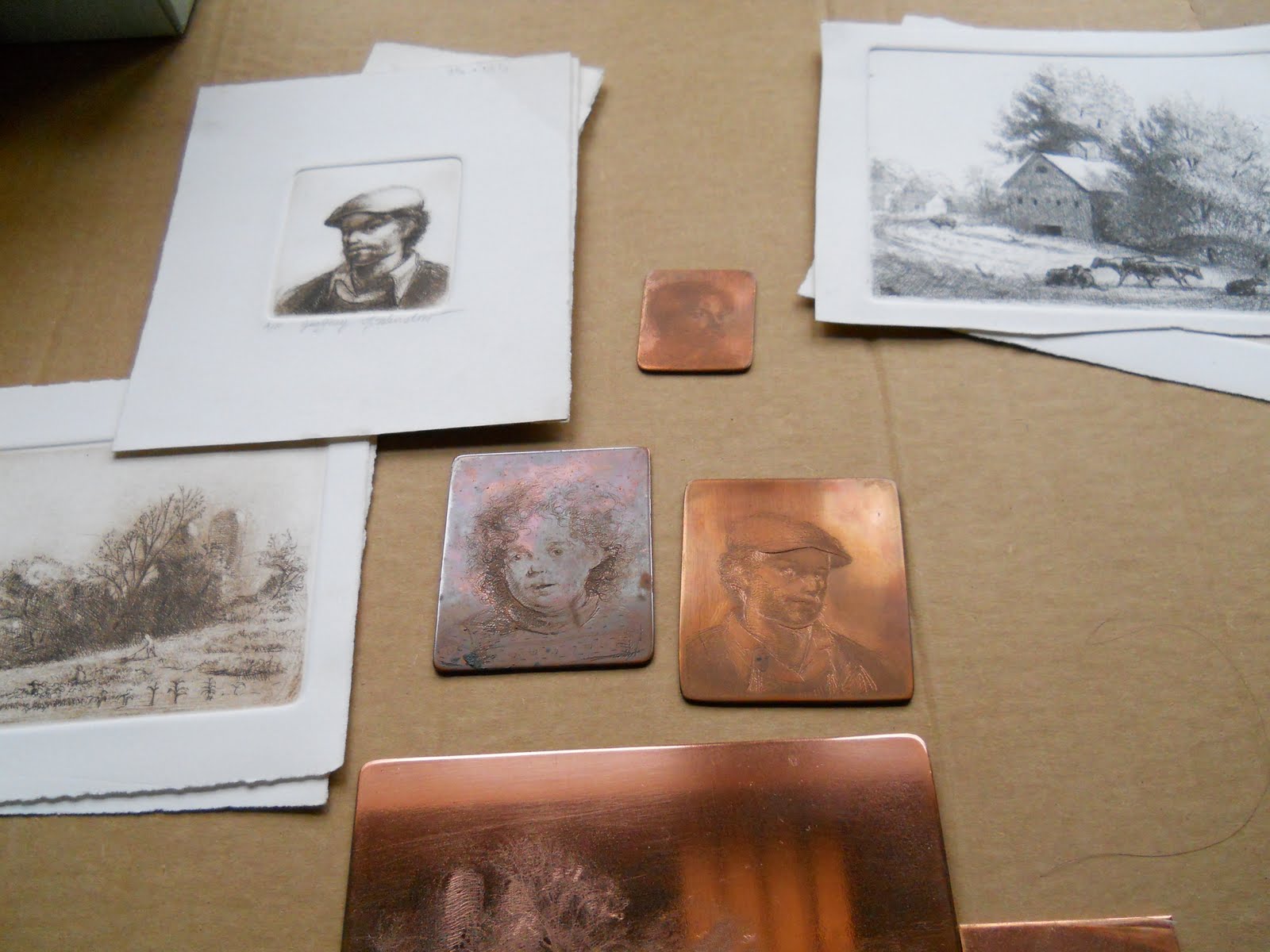
The photos above show a plain copper plate and one that has been sanded and polished. The edges of the plate have been filed smooth and rounded, so that when the plate is pulled through the press it will not cut the blankets. I am using a sewing needle that is inserted into a pencil holder as my scriber. The back of the plate has been covered with tape, and stop-out varnish is painted around the edges. I decided not to place the plate in a bath of acid, but rather pour a small amount of acid on the plate and feather is around. I discovered that nail polish was a much better stop-out varnish, because it dried faster than the regular commercial stop-out.

When I removed the ground, I held the plate up to white refrigerator so I could see the image. The following day, I reground the plate with universal liquid hard ground and continued to draw, and then exposed these new lines to the acid. The new lines show up as light pink. When this ground was removed, I rubbed a little oil paint into the lines so that I could see the image. I will probably pull a few prints to see how this looks. The image, when it is printed will be in reverse.

The last photo shows some plates and prints. All of the the plates are copper, and some are tarnished, but you can the the images a little better. I am still working on some of these. When I am satisfied with my images, I will pull some prints.

Monday, March 21, 2011

Open Figure Drawing Sessions


Trying to host an Open Figure Drawing group in a rural area of Vermont is difficult. Attendance is often sparse, but we did manage a few sessions in January and February. These were short pose sessions where the model would take a variety of poses lasting from one minute gestures to 20 minutes. I worked with conte crayons, pastel pencils and a fountain pen on pastel paper. Above are a few of my drawings from some of these sessions. My new thought is that I will try to offer 2 short pose open sessions for drawing and 2 long pose open sessions for painting (or more finished drawings) each month. Hopefully, this will keep the artists inspired. For me, it is encouraging to be around other artists, where we can energize and learn from each other.

Artists who live closer to metropolitan areas have abundant opportunity to choose from many open figure drawing/painting sessions that are offered, sometimes on a daily basis. I hope that if you are an artist, you are able to take advantage of these sessions. Being able to draw from the figure will help hone your observational, as well as drawing, skills, and it will help you in painting and composition.

Thursday, January 06, 2011

Winter Landscapes


January 6, 2011 - Happy New Year everyone! I paint plenty of summer, spring & fall plein air paintings, but I am a wimp when it comes to painting outdoors in the winter. Usually, if I paint landscapes in the winter, I sit in my car with heat on, and paint little studies using watercolor and gouache. Well, today I decided to try out my "Winter" set-up to see if I could manage an outdoor oil.

In the top picture, you can see my set-up. I am using an Open Box M easel that is attached to a tripod. Jack made the little palette box, and I premixed 6 strings of colors in 6 value steps. I have the easel opened all the way, so that the mixing area is fairly vertical. Jack made the panel, and it is coated with homemade gesso from Sarti chalk, which is somewhat absorbent, and toned with rabbit skin glue and dry pigment.

My footwear wasn't really adequate for the cold, so I put down a foam mat to stand on, so it could insulate me from the snow. I wore thin woolen gloves, but handwarmers would have helped.

I painted for around 1 hour and 25 minutes, or until my fingers were too stiff and cold to move, and the result is this little 8"x10" study. It was a fun start to the new year and I hope to do many more winter plein air studies!

Sunday, November 28, 2010

Open Figure/Portrait Sessions 2011


Trying to find the right schedule for my Open Figure/Portrait Sessions has been difficult. I started by hosting a 3 hour session every Saturday with a long pose so that artists work alla prima. I changed it to 4, then 5 hours, twice a month (instead of weekly). Attendance fluctuated greatly, which was very frustrating.

For 2011, I am going back to my original idea...a 3 hour long pose session once a week. The difference will be the day. Instead of Saturday, I am switching this to Wednesdays from noon to 3pm. Again, this is not a class, so artists of all abilities are welcome to come and draw or paint from the model. The drop-in fee will be $10. However, for $50. , paid in advance, the artists can come for 6 session, which will give them one free session. I think that this will be a great idea, and I am hoping that the new day will help.

In addition to the Long Pose Session, I am adding a Short Pose Session, which is more suitable for drawing. The Short Pose Session will be on Thursday evenings from 6pm-8:30pm. The model will take a variety of changing poses, from 1 minute gestures to 20 minute studies. The drop-in fee will be $8., but artists paying $40. in advance can come for 6 sessions, which again gives them one free session.

If there is enough interest, I will add an evening Long Pose Session. Let me know what you think of these changes.

Workshops 2011

I just updated the information on my Workshops in 2011. You can read descriptions on my website: www.WinslowArtStudio.com on the Workshops page. All of my workshops are intensives that run the full day, and all of the work will be from life where the artists will be analyzing light, form and depth. The principles I teach can be used in any medium, and students can use oils, watermedia or pastels. My workshops are intended to help the artist learn to translate what they see into a believable light effect, so they are more about learning to "see". The classes are not meant to give you a "finished" painting or project, but the help you learn artistic principles that you can put into practice, applying them to your own work long after the workshop ends.

Monday, November 22, 2010

8"x16" Paintings


Normally, my husband Jack makes all of our panels, but because I tend to paint very fast, I wind up using up the lion's share of his effort. So, I decided to supplement my supply and try out some commercial panels. All of these paintings were done on Ray Mar panels, which are double oil primed and 8"x16". The panels come in packs of 10, and this is a great size for little landscapes as well as still life paintings. As usual, all of these paintings are from life. So far, I have painted in the horizontal format, but I am thinking of trying a few vertical paintings soon.

Friday, November 19, 2010

More Paintings from the Sylvan Gallery Holiday Show


Here are a few of the plein air paintings on exhibit at Sylvan Gallery in Clinton, CT. I thought you might enjoy seeing my plein air set-up with me painting one of the pictures. It was painted at the Basin Harbor Club in Vergennes, VT. The top picture is a plein air painting that was done in Clinton, CT, and it is one of my largest plein air pieces. I normally paint fairly small when I paint outdoors.

Sylvan Gallery Holiday Show 2010


Every year Sylvan Gallery in Clinton, CT ( where I exhibit) has a Holiday Show. Most of the paintings are small, and I put in a number of pieces this year. I try to do a couple of "Holiday Theme" paintings (which are really fun to do). In addition to the small still life paintings and themed paintings, I exhibit several of my plein air paintings, and I will add those photos next. If you are in the area, please stop in.

Saturday, November 13, 2010

Open Session 11/13/10


Today's was a beautiful, sunny day in Vermont with temperatures in the 50s, which is rare for this time of year. So, some of the regular painters decided to enjoy the outdoors, and only a few of us painted the model. Lori posed for 4.5 hours. I thought you might enjoy my painting sequence. I am painting on one of the panels Jack made for me for my birthday. He makes his own gesso, and this gesso was made with Sarti Chalk, which is a pale yellow (very beautiful). It has an interesting and somewhat absorbent surface.

As usual, I start out very loosely and work from the general shapes to the more specific details. I use mostly large/medium round and filbert bristle brushes, but as I tighten up my drawing (getting more specific), I will use smaller, softer sables or mixed synthetic brushes. The final result for the day is a 12"x16" study.